First Flag Raising
The First American Flag: George Washington, Prospect Hill and the Birth of the United States
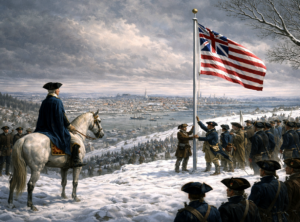 On New Year’s Day, 1776, George Washington ordered the first American flag raised to the top of a 76-foot liberty pole at the summit of a hill in Charlestown (now Somerville), Mass. Standing in formation on the hillside, several thousand soldiers watched the red, white and blue flutter against the sky. Redcoats saw it from the ships at anchor in the harbor and from their quarters in Boston, across the Charles River. The town’s inhabitants, patriots and loyalist alike, could see the flag, and so could the country people in the snow-covered fields beyond the hill.
One after another, 13 cannons boomed, and the troops on the hillside let out loud “huzzahs!”
Washington had ordered the first American flag raised to recognize the national fighting force. He intended the ceremony to boost morale and unite the troops, who came from disparate backgrounds. He chose Prospect Hill, nicknamed “The Citadel,” because of its commanding views of the British troop movements.
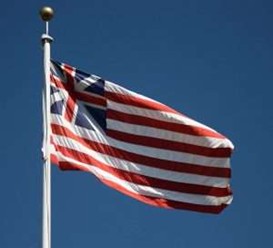 But the flag meant something even more than that. It was the first to represent all 13 colonies. Until then, each colony used its own flag. The raising of the flag with a stripe for each colony signified the birth of a republic called the “United States of America.”
Washington’s Irish aide-de-camp, Stephen Moylan, wrote those four words in a letter the next day–the first time ever, according to scholars. He expressed his desire for an appointment as ambassador to Spain. He wrote:
“I should like vastly to go with full and ample powers from the United States of America to Spain.”
The Continental Army
Washington almost didn’t have an army to command that day. After the Continental Congress created the Continental Army on June 14, 1775, most enlistments were very short, either for a few months or until the end of the year.
Since the Battle of Bunker Hill, the bulk of the army surrounded Boston, besieging the redcoats bottled up on the peninsular town.
But the patriotic fervor that had inspired thousands to join their local militias and march to Boston had largely subsided during the stalemate. The army had no hope of attacking the redcoats. The Continentals had inferior weapons and almost no artillery. They had so little gunpowder that Washington ordered spears issued to them.
They also had no winter clothes, few blankets and little firewood. As winter set in the men had to eat their rations cold. As the siege dragged on, the army began to melt away.
Washington himself thought it a near-miracle that the untrained, undisciplined militias had kept the British holed up in Boston for six months. If they somehow won the siege, Washington told John Hancock, he would view it as the luckiest thing that ever happened to him. more…
On January 1, 1776, George Washington ordered the raising of the “Grand Union Flag” over Prospect Hill.
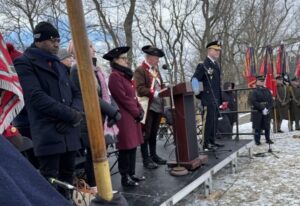
 The Bedford Minuteman Company represented Bedford at the 250th First Flag Raising, produced by the Somerville Museum and the City of Somerville.
According to the Somerville Museum website, “Every New Year’s Day, the city of Somerville commemorates an important moment of the American Revolution, the first flag raising. The event re-enacts the one that took place on Prospect Hill on Jan. 1, 1776. General George Washington raised a new American flag on that day over the highest point in the land, Prospect Hill in Somerville.”
“By December 1775, the Siege of Boston had dragged on for eight months with no clear outcome. Winter had arrived, morale was low, and soldiers had not been paid. The future of the Continental Army, especially as enlistments were ending, seemed uncertain.
“To unite the colonies, General Washington requested a new national flag that was authorized by Congress in December 1775. The first flag, known as the ‘Great Union Flag,’ combined the British Union Jack with 13 alternating red and white stripes, symbolizing the 13 colonies.
“On Jan. 1, 1776, in response to King George III’s declaration of war, Washington ordered the new flag to be raised on Prospect Hill. This bold act signaled the colonies’ determination to remain independent.”
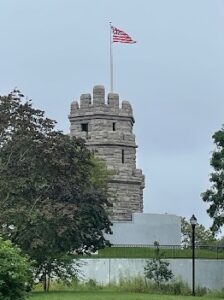
The Prospect Hill Monument also occasionally called the Prospect Hill Tower is a stone structure in Somerville, Massachusetts. It is a block away from the heart of Union Square, a neighborhood in Somerville. Its name is formally the Prospect Hill Memorial Flag Tower and Observatory. more…
MA Militia Narrative
click on picture
First Flag Raising – Information
First Flag Raising – Pictures